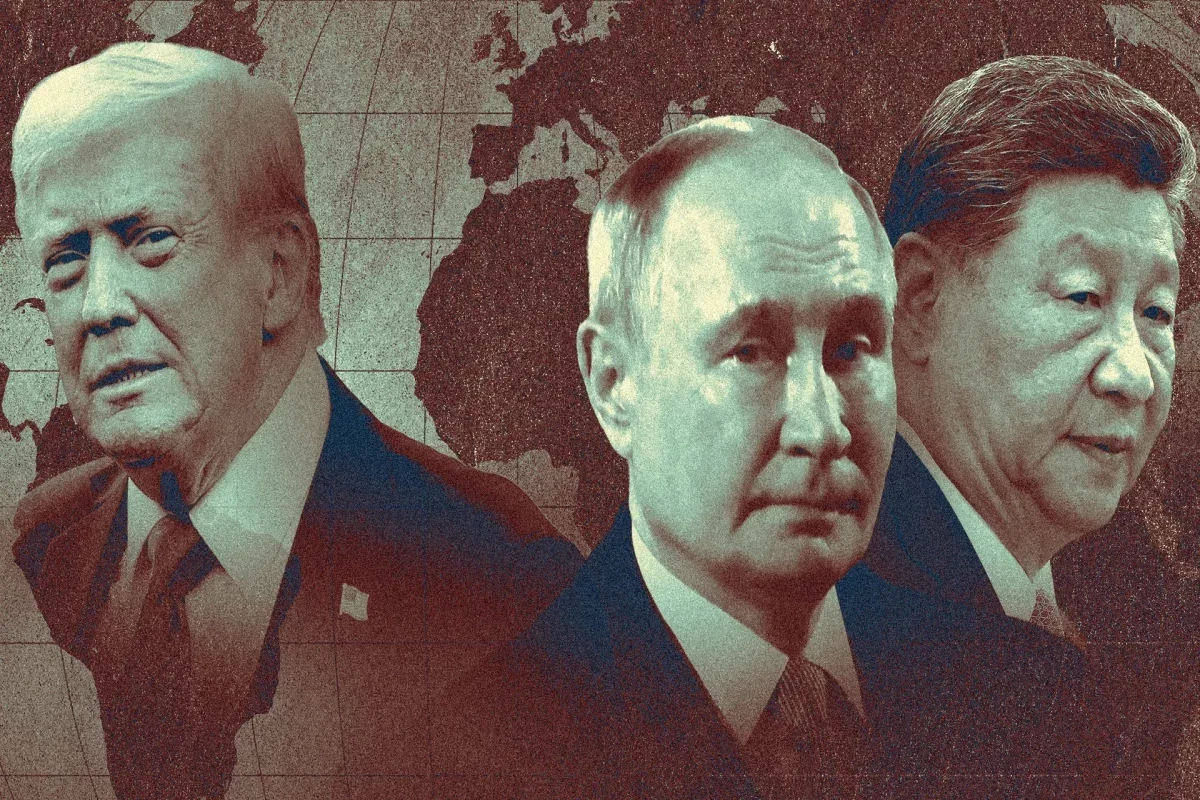





A possible trilateral summit involving Chinese President Xi Jinping, Russian President Vladimir Putin and US President Donald Trump could mark an important moment in global diplomacy. Amid rising geopolitical tensions, such a meeting could provide an opportunity to discuss strategic stability, nuclear arms control, regional conflicts and the future of international relations.
To explore these issues, News.Az interviewed China expert Kairat Maratovich Batyrbayev, Executive Director of the Eurasian Association of International Studies (Kazakhstan), about the potential implications of such a summit for global security and the Eurasian region.
– Mr Batyrbayev, how do you assess the historical and geopolitical significance of a possible trilateral meeting between the leaders of China, Russia and the United States? Could such a summit mark the beginning of a new mechanism for managing relations among the world’s leading powers?
– The significance of such a meeting would
– The significance of such a meeting would be primarily symbolic and procedural. For the first time, the leaders of three countries that are permanent members of the UN Security Council and possess some of the world’s largest military and economic capabilities could sit at the same negotiating table. The very fact of direct dialogue at the highest level would reduce the risk of miscalculations and mutual misunderstandings, which is particularly valuable under current circumstances.
It is premature to speak of establishing a new mechanism for managing relations. Such a mechanism would require not only political will but also an institutional foundation, including regular expert-level contacts, clear rules and mutual predictability. A single meeting would not normally create such a mechanism, but it could provide positive momentum.
It is fundamentally important that any agreements complement the existing system of international law and the role of the United Nations rather than replace them. From this perspective, Kazakhstan is interested in strengthening dialogue among major powers as a factor contributing to global stability.
– What are China’s main strategic objectives
– What are China’s main strategic objectives and expectations regarding the upcoming summit? To what extent could Beijing play a mediating or balancing role between Washington and Moscow, particularly given the existing disagreements between the two countries?
– For China, as the host country, the meeting would primarily reaffirm its role as a responsible power interested in maintaining a stable international environment. Such stability is essential for Beijing to pursue its domestic development priorities and maintain trade and economic relations. China has consistently emphasised its commitment to peace, dialogue and the principle of equality among states.
As for mediation, China possesses certain prerequisites for playing such a role. It maintains working relations with both sides and has considerable economic influence. However, it is important to assess realistically the limits of what is possible.
Mediation is effective only when the parties themselves
Mediation is effective only when the parties themselves are interested in finding a compromise. China will likely seek to create favourable conditions for dialogue rather than assume the role of an arbitrator.
It should also be recognised that Beijing has its own approaches to particular issues, including the format of discussions on arms control. This is natural for any major power, and such positions will influence the summit’s agenda.
– Which major international challenges are likely to dominate the negotiations? In particular, could nuclear arms control, the war in Ukraine, regional conflicts and global strategic stability become central issues? Is there a realistic possibility of reaching concrete agreements on at least some of these matters?
– Judging by the public statements
– Judging by the public statements of the parties, strategic stability, including nuclear arms control, as well as several regional crises, will likely be among the central topics. However, the participants currently have different approaches to priorities and the format of discussions. Therefore, the final agenda will become clear during the meeting itself.
The most realistic area for progress appears to be strategic stability, particularly confidence-building measures, communication channels and efforts to reduce the risks of escalation.
This is where the interests of the parties overlap most significantly, since the consequences of a miscalculation would be severe for everyone.
Regarding regional conflicts, Kazakhstan has traditionally maintained
Regarding regional conflicts, Kazakhstan has traditionally maintained that they should be resolved peacefully, on the basis of the UN Charter and universally recognised norms of international law. Any progress towards a negotiated settlement would be viewed positively.
At the same time, rapid and comprehensive agreements should not be expected, as achieving them requires sustained and consistent efforts. Even a reaffirmation of the parties’ willingness to continue dialogue could be considered a tangible outcome.
– Could the Shenzhen summit contribute to the emergence of a new international order in which China, Russia and the United States play a decisive role? What consequences might such developments have for small and medium-sized countries, including Azerbaijan, and for the Eurasian region as a whole?
– It would be premature to associate this
– It would be premature to associate this meeting with the formation of a new international order. The contemporary international system is multipolar and multilayered, involving the United Nations, regional organisations and groups of states with differing interests.
The role of major powers is undoubtedly significant, but no single meeting can invalidate the sovereign equality of states, which is a fundamental principle of international law.
For small and medium-sized countries, what matters is that dialogue among major powers contributes to reducing tensions and that issues affecting other countries are discussed with their participation and with respect for their sovereignty.
The experience of Kazakhstan and Azerbaijan demonstrates
The experience of Kazakhstan and Azerbaijan demonstrates that a multi-vector, pragmatic foreign policy makes it possible to develop partnerships with all key international actors while protecting national interests.
For Eurasia, the most important priorities are maintaining stability and preserving open trade and transport connections.
The development of transport corridors, including the Trans-Caspian route, as well as cooperation between our countries in connectivity and energy, strengthens regional resilience regardless of fluctuations in relations among major powers.
It is precisely this kind of cooperation, based on mutual benefit, that provides a solid foundation for regional security.