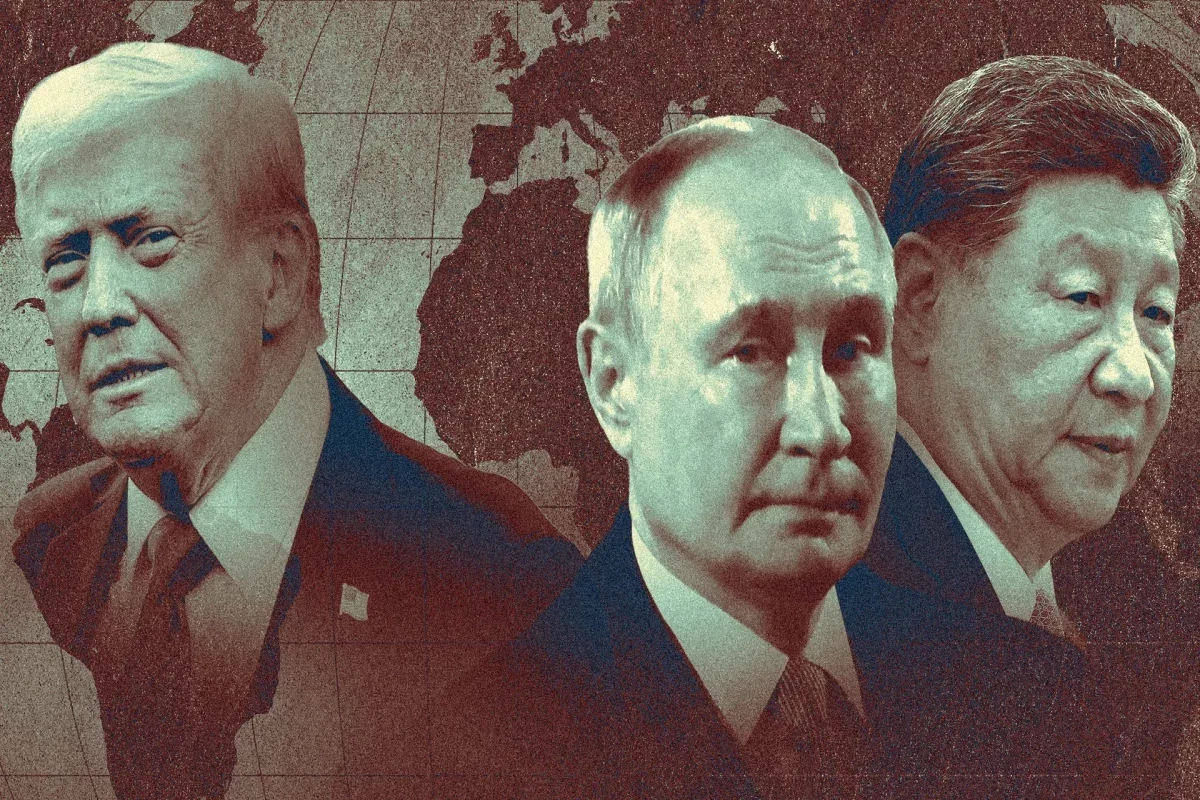




If the proposed trilateral summit takes place, its main significance will lie in overcoming the 81-year gap since the Yalta Conference of 1945. The meeting is already being compared to Yalta 2.0, a concept actively circulating in expert circles. However, most analysts, myself included, agree that today’s circumstances are fundamentally different.
This is certainly not about dividing spheres of influence in the aftermath of a world war, nor are there any victorious powers. Rather, it is an attempt to stabilise relations under conditions of multipolarity and address the factors contributing to growing international turbulence.
From a geopolitical perspective, perhaps the most important aspect is the recognition of Russia as an independent centre of power. For Moscow, which remains under sanctions, participation in a trilateral meeting at the highest level on a neutral platform such as China would provide visible confirmation that Russia is not isolated and retains its status as a global power without which major security issues cannot be resolved.
As we understand it, the meeting would also
As we understand it, the meeting would also send a signal to the world that three nuclear powers are attempting to agree on at least the minimum rules of coexistence at a time when bilateral communication channels are struggling to cope with the scale of existing crises, including the war in Ukraine and developments in the Middle East.
These are controversial and sensitive issues that are difficult to resolve through bilateral negotiations alone. Consequently, a summit involving three major nuclear powers could allow existing global problems to be examined from different perspectives and potentially help identify common approaches to addressing them.
Regarding expectations, Moscow will probably focus on the issues that concern it most, particularly Eurasian security and the development of a security architecture under present circumstances.
Most likely, discussions will centre on how
Most likely, discussions will centre on how the three powers perceive developments around the world and how international conflicts might be overcome. However, the conflict in Ukraine will probably not be addressed directly because Beijing does not seek to become the principal mediator on Ukraine, viewing it primarily as a European issue.
China is unlikely to turn the summit into a platform for discussing a settlement in Ukraine without European participation.
Moscow, meanwhile, wants to present itself as one of the principal powers capable of discussing the emerging global security architecture. It believes that major security challenges and disputes should, wherever possible, be addressed through high-level dialogue among leading powers.
The summit would reinforce Moscow’s position not merely
Furthermore, the summit would reinforce Moscow’s position not merely as an advocate of a particular international vision but also as an active geopolitical player that cannot be isolated, regardless of the intentions of certain European countries.
The summit could indeed generate momentum towards reducing tensions, although its potential to establish a sustainable new mechanism of cooperation among the three powers remains limited.
What is more likely is an attempt to initiate crisis management and restore high-level dialogue rather than establish a fully developed institutional structure.
The meeting’s agenda is relatively flexible,
The meeting’s agenda is relatively flexible, and the fact that the summit takes place may be more important than the specific issues discussed.
If the meeting is successfully organised and followed by further summits, that would already constitute a significant achievement.
The establishment of a relatively permanent format for meetings among the three great powers would create a new reality, allowing certain issues to be addressed through the combined influence of the United States, China and Russia.
Such a mechanism could contribute to reducing tensions
Such a mechanism could contribute to reducing tensions and encouraging more open dialogue among the countries.
However, the participants have fundamentally different expectations, which naturally reduces the chances of a breakthrough.
There is no single common objective or threat that has brought the leaders together.
The United States will insist on discussing nuclear issues and reducing nuclear arsenals. Washington wants to involve China in nuclear arms control negotiations.
Beijing, however, considers such negotiations premature, arguing
Beijing, however, considers such negotiations premature, arguing that China’s nuclear arsenal is several times smaller than those of the United States and Russia. From China’s perspective, involving it in nuclear reductions at this stage would therefore make little sense.
Russia is interested in discussing the broader agenda of establishing a global Eurasian security system. Naturally, Moscow would also be interested in addressing Ukraine, but this issue is unlikely to be raised because China does not favour such a discussion.
Beijing does not want to present itself as a venue where questions directly affecting European countries are settled without their participation.
China would probably prefer to focus on broader
China would probably prefer to focus on broader and less contentious subjects, including economic stability, trade partnerships and reducing competition.
Each country therefore approaches the summit with its own vision.
Nevertheless, direct dialogue among the leaders could reduce the risk of escalation simply by restoring a high-level communication channel that had previously been disrupted.
Expectations of a breakthrough settlement of the conflict in Ukraine should remain low.
The most likely outcome would, at best, involve a formal clarification of positions and possibly the launch of a consultation mechanism among the parties rather than a ceasefire.
The leaders might discuss establishing a working group
The leaders might discuss establishing a working group or communication channel to address humanitarian issues.
These could include prisoner exchanges, the fate of children, the reopening of ports or nuclear safety at the Zaporizhzhia Nuclear Power Plant.
Such issues are comparatively less contentious, making an overlap between American and Chinese interests more likely.
It is doubtful that the fundamental causes
It is doubtful that the fundamental causes of the conflict or comprehensive security guarantees will be discussed.
Beijing, according to available information, does not seek to assume a mediating role in Ukraine and regards the conflict as a European matter.
Washington is also unwilling to conduct substantive negotiations over territorial questions without Kyiv and Europe.
Consequently, expectations of a comprehensive agreement on Ukraine in Shenzhen would be unrealistic.
On nuclear arms control, however, limited progress may
On nuclear arms control, however, limited progress may be possible because strategic stability remains a sensitive issue for all three capitals.
The parties could discuss restoring dialogue on the Strategic Arms Reduction Treaty. Although the treaty was due to expire in 2026, the sides might agree to initiate technical consultations.
They could also exchange commitments aimed at preventing accidental escalation and restoring emergency communication channels.
The United States wants China to participate
The United States wants China to participate in negotiations concerning nuclear arsenals, but Beijing considers its arsenal incomparable in scale to those of Russia and the United States.
China is therefore unwilling to join existing bilateral frameworks.
A trilateral format might consequently produce only a general agreement to continue negotiations rather than concrete figures for reducing nuclear weapons.
Regarding international security, expectations should primarily centre on lowering the risk of escalation and restoring communication channels.
It is unlikely that the three countries will
It is unlikely that the three countries will directly discuss the establishment of an entirely new security architecture without the participation of other major international actors, including Europe.
A joint statement declaring the inadmissibility of the use of nuclear weapons is possible.
The participants might reaffirm that no side can win a nuclear war.
There could also be discussions concerning cybersecurity, confidence-building measures in cyberspace, the prevention of incidents in outer space or the resumption of consultations through national security councils.
In this context, even renewed dialogue would be a positive development for everyone. If negotiations produce concrete results, the format could potentially continue. However, experts generally do not expect the summit to deliver precise commitments or major binding decisions. Instead, they anticipate broad declarations and expressions of willingness to negotiate.
The proposed meeting could also influence the Russia-China
The proposed meeting could also influence the Russia-China strategic partnership, although primarily at the symbolic and tactical levels. It is unlikely to alter the fundamental foundations of the partnership, but it could adjust certain aspects and provide fresh momentum to the narrative of multipolarity. Putin’s participation in a trilateral summit organised by Xi Jinping would reinforce the image of Russia as a country that has not been internationally isolated. At the same time, it would reaffirm China’s role as a major diplomatic power capable of bringing together leaders of global significance.
For Moscow, the meeting would send an important signal that Beijing is not distancing itself from Russia in order to maintain dialogue with Washington. Instead, through a trilateral format, China would demonstrate its willingness to engage simultaneously with both Russia and the United States. The summit would also allow Moscow and Beijing to coordinate their positions on key issues, including nuclear stability, nuclear non-proliferation, bilateral relations and, potentially, their joint approach to the American agenda. Such discussions would take place through direct, open communication in real time rather than exclusively through diplomatic channels.
It is important to understand that China, as the host, will seek to maintain control over the agenda. Beijing is unlikely to allow the summit to develop into an anti-American, anti-Russian or anti-European front. Instead, China will attempt to maintain a balance. The meeting would probably demonstrate that the fundamental elements of the Russia-China partnership remain strong, particularly economic cooperation, technological collaboration and opposition to any form of hegemony.
Regarding the balance of power and the multipolar
Regarding the balance of power and the multipolar world, the summit would provide another indication that global politics can no longer be reduced to the G7 and everyone else. It would reinforce the Russian-Chinese argument that multipolarity is no longer merely an aspiration but an existing international reality. The very fact that three nuclear powers would meet on a non-Western platform would signal a gradual shift in the centres of international decision-making towards the East and countries of the Global South.
Nevertheless, a format involving only three major powers does not represent genuine multipolarity. True multipolarity also requires the participation of countries such as India and Brazil, the European Union and various regional organisations. If the international community perceives the summit as an attempt to establish a new directorate of three great powers, it could raise concerns among other centres of influence. Such concerns might actually slow the development of broader multipolarity.
For this reason, any joint statements are likely to contain cautious and flexible language. They are unlikely to fundamentally alter the existing global balance of power. Instead, the meeting would strengthen the narrative of multipolarity and demonstrate Russia’s and China’s willingness to coordinate their actions. At present, neither country appears prepared to establish a new institution as an alternative to broader international formats. The principal effect would therefore be symbolic: demonstrating that the world’s largest centres of power remain capable of coordinating their positions rather than creating a rigid new geopolitical bloc.
Although the summit could mark the restoration
Although the summit could mark the restoration of high-level dialogue, the three countries continue to hold fundamentally different positions on key strategic questions. These differences make long-term agreements difficult to achieve under present circumstances. Washington seeks to include China in negotiations on reducing nuclear weapons. Beijing, however, insists that the United States and Russia should first substantially reduce their arsenals. China refuses to bind itself to new restrictions that do not reflect the relative size of its nuclear capabilities.
The most realistic result would therefore be a joint statement rejecting the possibility of nuclear war or discussions on the risks associated with the use of artificial intelligence in the nuclear sphere. This would be more achievable than the specific numerical reductions in nuclear arsenals sought by Washington.
As for the summit’s impact on Eurasia and the South Caucasus, its consequences are unlikely to be direct. The region is not a central focus of the agenda, as the primary attention will remain on global strategic stability. Consequently, regions such as the South Caucasus are unlikely to feature prominently in trilateral negotiations. It would therefore be difficult to expect major changes in the participating countries’ positions on regional issues.
The most realistic outcome would be the establishment
The most realistic outcome would be the establishment of a dialogue mechanism and the achievement of a minimum consensus, such as an agreement on the inadmissibility of nuclear war. For Eurasia and the South Caucasus, the summit is unlikely to produce specific agreements. Rather, it would send a signal that the great powers are maintaining communication. That in itself would be a positive development for international security, even if it does not lead to any fundamental restructuring of the regional order.
(If you possess specialized knowledge and wish to contribute, please reach out to us at [email protected]).