

Published byAlok Mehta
Last updatedNovember 22, 2026 02:59:35 IST
India’s absence reflects APEC’s regional mandate, not weakness in its international standing.
Congress leader and Leader of the Opposition Rahul Gandhi, while in the United States, took to social media to attack India’s democracy over the APEC Summit, commenting that “if the Congress government were in power, India’s Prime Minister would have been sitting at this table. A compromised Prime Minister can never sit at this table.” His direct target was Prime Minister Narendra Modi, who has been elected to the office three times and is widely appreciated by leading global organisations and heads of state and government. Before making such an objectionable remark and exposing his ignorance, Rahul Gandhi should have checked the facts with an adviser or even through a simple Google search.
As a Member of Parliament, Rahul Gandhi has served for several years on the Parliamentary Consultative Committee of the Ministry of External Affairs and is currently also a member of the Parliamentary Committee on Defence. Yet, he appears unaware of the basic fact that the APEC Summit is a meeting of countries bordering the Pacific Ocean. India is located in the Indian Ocean region and, therefore, is not a member. Consequently, no Indian Prime Minister has ever sat at this table, whether under a Congress government or any other dispensation.
Moreover, in 1991, the government of Congress Prime Minister P V Narasimha Rao applied for India’s membership of the organisation, which was established in 1989. However, India was not granted membership during his tenure or during the subsequent ten years when Manmohan Singh, who had served as his Finance Minister, was Prime Minister.
It may be called coincidence or diplomacy,
It may be called coincidence or diplomacy, but after Narendra Modi became Prime Minister in 2014, China’s President invited India only as a guest to the APEC meeting held in Brazil. However, the Indian government declined to attend as an observer without membership. APEC currently has 21 member economies, including the United States, China, Russia, Japan, Australia, South Korea, Canada, Indonesia, Vietnam, Singapore and other Pacific Rim economies. The organisation is not a military alliance. Its primary objective is to promote trade, investment, technological cooperation and economic development.
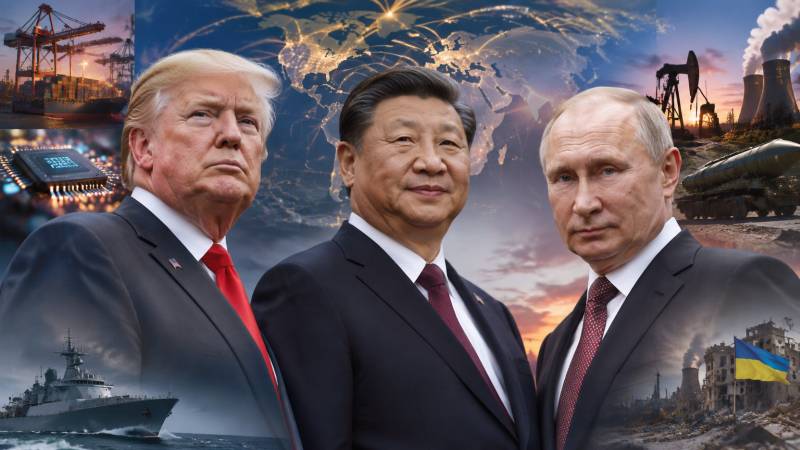
The 33rd summit of the Asia-Pacific Economic Cooperation (APEC), held in China’s Shenzhen on November 18-19, emerged as a significant event in global politics. The first joint trilateral meeting between US President Donald Trump, Russian President Vladimir Putin and Chinese President Xi Jinping opened up new possibilities in international diplomacy while also raising several serious questions.
This was not merely a meeting of three presidents. They represent three major powers with significant political, economic and strategic differences. The United States and China are competing over global trade, technology and strategic influence. US-Russia relations have been affected by the Ukraine war and sanctions. Meanwhile, economic and strategic proximity between Russia and China has increased over the past few years.
Under these circumstances, the coming together
Under these circumstances, the coming together of the three leaders on one platform is significant. However, the biggest question for India is whether any new understanding between the United States, China and Russia will alter the global balance of power. And will India be able to maintain its independent and influential role in this changing international order?
The November 19 meeting between the presidents of the United States, Russia and China — Trump, Putin and Xi Jinping — on the sidelines of the summit brought global security and relations among major powers into focus, apart from the economic agenda. Following the approximately 90-minute trilateral meeting in Shenzhen, a joint declaration was issued covering four major subjects. First, the need for reforms in the United Nations. Second, increasing the production and supply of petroleum products. Third, questions relating to international courts and the legal immunity of government officials. Fourth, cooperation to reduce the risk of nuclear war.
The Ukraine war was discussed during the meeting, but the joint declaration did not offer any clear resolution. No decisive agreement emerged on Iran or the crisis in West Asia either. This means that the three countries have opened a channel for dialogue, but their fundamental political differences remain unresolved. In particular, the approach towards limiting the powers of international courts is controversial. Supporters of human rights, accountability for war crimes and international law may view it as an attempt to weaken accountability.
Chinese President Xi Jinping played the most significant
Chinese President Xi Jinping played the most significant role at this summit. By bringing the three major powers together on its soil, China demonstrated its role in international diplomacy. This is in keeping with China’s long-term strategy of seeking to become not merely a major global industrial and export hub but also a leading architect of the international political order.
India is not a member of APEC, but that does not mean it is outside Asia-Pacific politics. India is cooperating with the United States, Japan and Australia through the Quad. It participates alongside China and Russia in BRICS. India is also a member of the Shanghai Cooperation Organisation (SCO). India’s economic and strategic partnerships with ASEAN countries are continuously developing.
Thus, India is pursuing an independent foreign policy through various international platforms. It is also advancing its economic interests through other bilateral and multilateral arrangements.
Published byAlok Mehta
Last updatedNovember 22, 2026 02:59:35 IST
November 22, 2026 2:59 am