

Voters will decide who will become North Carolina’s next United States senator on Tuesday — a decision that could affect not just the political trajectory of the state but of Congress as a whole.
Democrats need to flip four Senate seats nationwide to take control of the chamber. Perhaps their best chance is North Carolina, where Republican U.S. Sen. Thom Tillis didn’t run for reelection after falling out of favor with Republican President Donald Trump.
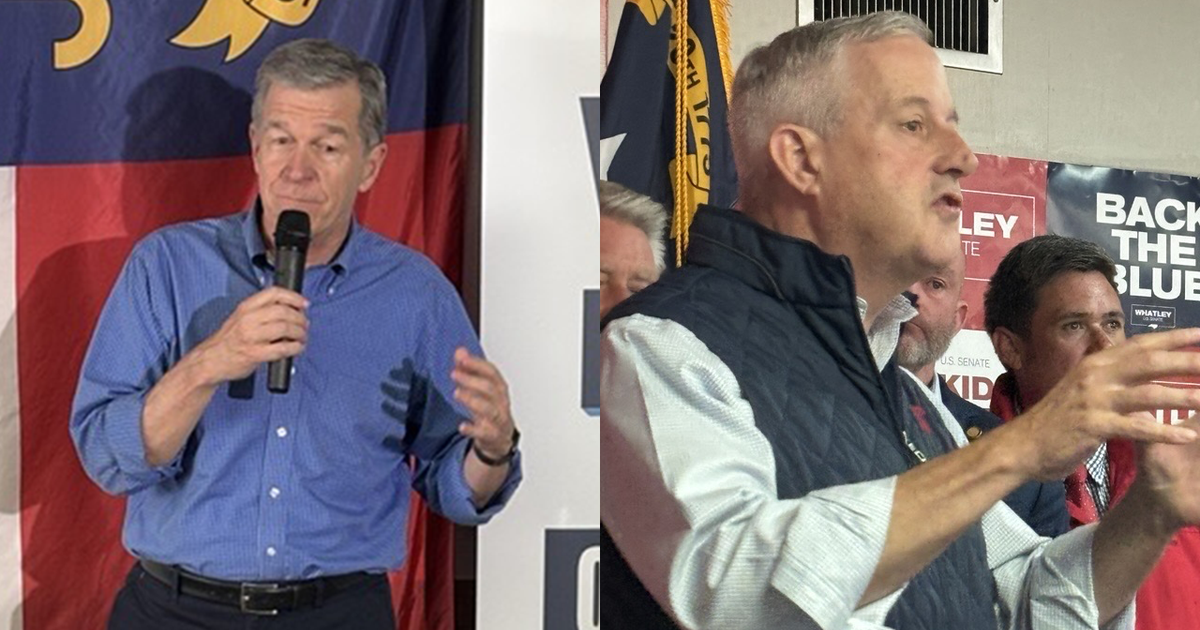
Trump endorsed former Republican Party boss Michael Whatley for the seat. Whatley has consistently trailed former Gov. Roy Cooper, the Democratic Party nominee, in polls and fundraising. Green Party nominee Michael Dublin and Libertarian Party nominee Shannon Bray are also running for the seat.
Democrats — who flocked to the polls in the state’s early voting period — are optimistic going into Tuesday. Unaffiliated voters make up the state’s biggest voting bloc and voters of all stripes have become frustrated with elevated inflation, polls show. They largely blame policies implemented by Republican President Donald Trump and supported by Republicans in Congress, such as tariffs and the war in Iran, for increased grocery and gas prices — sentiment that is expected to weigh on GOP candidates, analysts say.
Whatley has themed his campaign almost entirely around supporting Trump and his agenda. But while Whatley has tacked to the right, Cooper hasn’t tacked to the left. He has instead leaned into the more moderate image that helped him win two terms as governor — both in years when voters across North Carolina also backed Trump for president.
“I’ll be a strong, independent senator who will work with this president when I can — and stand up to him when the people need me to,” Cooper said in his acceptance speech after winning the Democratic Party primary in March. He sought to set the tone for the following nine months of campaigning, telling supporters: “I’ll work with anyone, anywhere, from any party to help make our state better and to make stuff cost less.”
Republicans have sought to convince voters not to believe Cooper’s claims of being a moderate who’s open to bipartisan cooperation. They’ve said that if he goes to the Senate, Cooper will drop his down-home, grew-up-on-a-farm persona and start adopting far-left stances.
“They want to bring socialism back,” Whatley said of Democrats, during a recent Trump rally in Gastonia. “They want Christians to be under assault. They want your families to be under assault.”
A WRAL/WSOC News Poll in mid-October, just before the start of early voting, found that among North Carolinians likely to vote this year, 60% disapproved of the job Trump has done since returning to the presidency nearly two years ago. Most also planned to vote for Cooper to replace Tillis in the Senate.
No Democrat has won election to the U.S. Senate in North Carolina in nearly 20 years, since the late Kay Hagan’s 2008 victory. She served one term before being unseated by Tillis in 2014. Libertarian Sean Haugh ran a prominent campaign in 2014, gathering nearly 4% of the vote — the strongest showing for a third-party Senate candidate this millennium in North Carolina — and allowing Tillis to claim victory despite failing to crack 50% support.
The recent WRAL/WSOC poll showed 1% of voters supporting either Bray or Dublin, plus another 5% undecided.
NC key to national Democrats’ hopes
If Cooper wins, it could put Democrats on a trajectory toward taking back the entire federal legislative branch. North Carolina is also home to 14 seats in the U.S. House of Representatives. Republicans would be expected to win 11 of those 14 seats in a typical year, but Democrats are competing in at least a few this year that were once thought to be out of reach.
National conservative groups that had promised spending tens of millions of dollars helping prop up Whatley’s campaign abandoned the state a month ago, shifting unspent recing unexpected pressure from Democratic challengers as Trump’s approval ratings plummet
The Elon Musk-funded Senate Leadership Fund pulled tens of millions of dollars out of North Carolina to redirect to Texas, Iowa and other conservative states where polls show Republicans on the ropes.
Whatley’s campaign also stopped airing ads on television nearly a month out from the election — generating concerns from GOP candidates down the ballot that if their party’s main candidate wasn’t pushing voters to come out and vote, they could find themselves in trouble as well.
Some of the state’s incumbent Republican members of the U.S. House have since started running ads of their own, lacking support from the top of the ticket and eyeing polls showing Democrats gaining ground.
Trickle-down effects for US House
At least one GOP-held U.S. House seat, the state’s 11th Congressional District in western North Carolina, is rated by nonpartisan observers as likely to flip blue this year.
Incumbent Rep. Chuck Edwards didn’t seek reelection while facing sexual harassment allegations that he denies, the Trump administration has delivered only a fraction of the money expected for Hurricane Helene relief — and Democratic challenger Jamie Ager has raised millions of dollars for the race, compared to just a few hundred thousand for his GOP opponent Jennifer Balkcom.
WRAL reported late last month that a number of Republican incumbents in the House started spending to run ads, even though they won in 2024 by large margins. They include U.S. Reps. Virginia Foxx, Richard Hudson, Greg Murphy and Brad Knott.
In northeastern North Carolina, incumbent Democratic Rep. Don Davis has remained in a tough battle with Republican challenger Laurie Buckhout. Their race is rated as a tossup by the nonpartisan Cook Political Report, even though Republican state lawmakers redrew Davis’ seat last year to make it lean heavily Republican in a normal year — the voters in the new version of the district supported Trump by 12% of the vote in 2024.