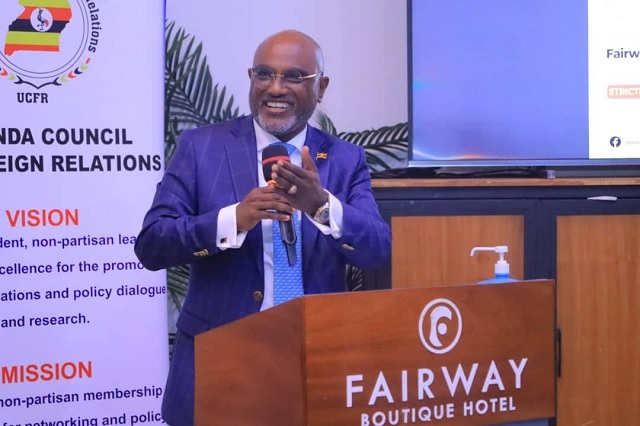



Foreign Affairs Minister Amb. Adonia Ayebare has called for a more economically driven foreign policy, urging closer collaboration between government, academia, business leaders and independent policy institutions to advance Uganda’s strategic interests
“Diplomacy for us, today and tomorrow, must become increasingly responsive to the economic aspirations of our people,” Ayebare said.
The minister was delivering his first annual address to the Uganda Council on Foreign Relations (UCFR) on Friday at Fairway Hotel in Kampala, as the institution marked its tenth anniversary.
His remarks come as Uganda seeks to attract
His remarks come as Uganda seeks to attract foreign investment, expand export markets and accelerate economic growth under the government’s Tenfold Growth Strategy, while navigating regional conflicts and an increasingly competitive global economy.
Ayebare identified artificial intelligence, emerging technologies, climate change, energy transition and public health as emerging foreign policy priorities. He also disclosed that the ministry was finalising a new diaspora policy to harness remittances, skills and investment from Ugandans abroad.
On regional security, Ayebare reaffirmed Uganda’s commitment to mediation, peace support operations, regional integration, non-alignment and respect for international law.
These principles have served us well and will
“These principles have served us well and will continue to guide our diplomacy in the coming decades,” he said.
Uganda remains actively involved in regional security, with military deployments in Somalia and eastern Democratic Republic of Congo, alongside diplomatic efforts to resolve conflicts in the Great Lakes region and the Horn of Africa.
Ayebare also reiterated Uganda’s support for reforms to the United Nations Security Council to secure permanent African representation.
UCFR Chairman Gen. (Rtd) Ivan Koreta called
UCFR Chairman Gen. (Rtd) Ivan Koreta called for broader participation in shaping Uganda’s foreign policy.
“Uganda’s place in the world should be shaped not only by government, but by informed dialogue, by independent thought, and by the collective wisdom of its people,” Koreta said.
The Council’s Chief Executive Officer, Amb. Francis Katana, said the institution was established in 2016 to bridge the gap between government and other stakeholders in foreign policy formulation.
The makers and executors were mainly the Executive
“The makers and executors were mainly the Executive and Parliament, but there was no direct input from civil society, business people and academia. So we thought we should have a forum that provides for this interaction,” he explained.
Over the past decade, the Council has facilitated discussions on regional security, trade, investment, migration and global governance.
Ayebare called on the institution to strengthen independent research, anticipate geopolitical shifts, develop policy options and preserve Uganda’s diplomatic institutional memory.
During the celebrations, former Foreign Affairs Minister Sam
During the celebrations, former Foreign Affairs Minister Sam Kutesa received recognition for his role in establishing the Council, alongside Katana, Amb. James Mugume, Prof. Mbabazi Mugumya, Amb. Fred Bayendeza and Koreta.
King Ceasor and Cavendish University Uganda were also recognised for their support to the institution.
Ayebare welcomed regular consultations between the ministry and the Council as Uganda seeks to navigate an increasingly complex geopolitical environment while leveraging its international partnerships to accelerate domestic economic growth.