

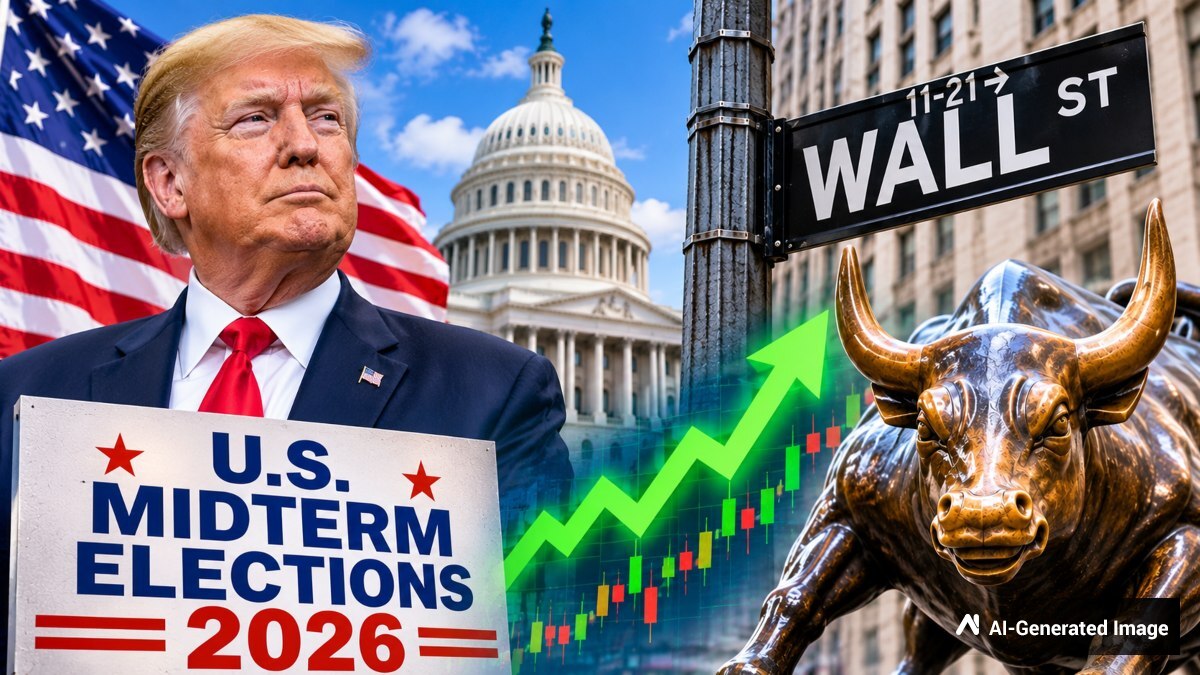
US Midterm Elections 2026: Wall Street has historically gained after US midterm elections, but Indian stock markets face a different set of challenges. US bond yields, the dollar, crude oil prices and foreign investor flows remain key factors for the Nifty and Sensex.
The US midterm elections on November 3 are drawing attention from investors across global markets. While Wall Street has historically delivered strong returns in the months following midterm elections, the impact on Indian stock markets is less straightforward.
For investors on Dalal Street, the bigger question is not simply whether Republicans or Democrats gain control of Congress. The focus is on how the election outcome influences US economic policy, interest rates, government spending, trade relations and corporate earnings.
With Democrats gaining ground in key Senate battlegrounds, the possibility of a change in congressional control has added another layer of uncertainty to the political environment. Recent New York Times-Siena polls show Democrats leading in several Republican-held states, bringing the Senate majority into focus.
However, the election result alone does not determine the direction of global equities. The movement in US Treasury yields, the dollar and crude oil prices remains central to understanding the potential impact on emerging markets such as India.
Sohom Banerjee, senior economic and AI expert, told NDTV that the midterm elections influence equity markets primarily through changing expectations around corporate earnings and the cost of capital.
US Stock Market: What History Says About Wall Street After Midterm Elections
Historical market performance offers an interesting perspective on the relationship between US midterm elections and Wall Street.
According to JP Morgan Asset Management data, the S&P 500 has recorded positive returns in the 12 months following every US midterm election since 1950. The average gain during these periods has been around 15%.
This trend reflects the importance of political clarity for financial markets. Once election-related uncertainty eases, investors get a better understanding of the legislative environment and the government’s ability to implement its economic agenda.
However, historical performance does not guarantee similar returns in every election cycle. Monetary policy, economic growth, corporate earnings and market valuations also influence stock market performance.
Morgan Stanley’s assessment is that the direct impact of the midterm elections on market-sensitive policies remains limited. Trade, geopolitical developments and regulatory decisions continue to carry greater significance for investors.
The political composition of Congress nevertheless matters. Continued Republican control provides President Donald Trump with greater room to pursue his legislative agenda, including tax and regulatory measures. A Democratic-controlled House increases congressional scrutiny of the administration and places limits on major legislative initiatives.
A divided Congress also brings a different set of considerations, particularly around government spending, funding approvals and the debt ceiling.
Indian Stock Market: How US Elections Affect Nifty And Sensex
For Indian investors, the relationship between US politics and domestic equities is largely driven by global financial conditions.
US Treasury yields are among the most important indicators to watch. When American bond yields rise, US fixed-income investments become more attractive relative to emerging-market equities. This can encourage foreign institutional investors to reduce their exposure to markets such as India.
A stronger US dollar also puts pressure on the Indian rupee. Currency volatility, in turn, influences foreign investment flows and sentiment towards domestic stocks.
This explains why Wall Street and Dalal Street do not necessarily move in the same direction, even when global investors respond positively to greater political clarity.
Indian information technology stocks are particularly sensitive to developments in the US economy. America remains a major market for Indian IT services companies, making technology spending by US businesses an important factor for the sector.
Higher spending on technology, artificial intelligence and digital transformation supports demand for Indian IT services. However, tighter corporate budgets and slower technology spending affect outsourcing orders and revenue growth.
A weaker rupee also improves the conversion value of overseas earnings for Indian IT companies. However, currency benefits alone cannot compensate for lower demand, pricing pressure or rising operating costs.
Crude Oil Prices Remain A Key Concern For Dalal Street
Crude oil is another important factor in determining the impact of US midterm elections on Indian equities.
India imports a significant share of its crude oil requirements. Any sustained increase in international oil prices raises the country’s import bill and adds pressure on inflation, the rupee and corporate profitability.
Higher energy costs affect several sectors, particularly araw material expenses. Upstream oil producers, on the other hand, may benefit from higher crude prices
This means a favourable outcome for Wall Street does not automatically translate into positive sentiment for Indian equities.
Will Indian Stocks Follow Wall Street After US Midterms?
Historical data shows that Indian equities have not consistently replicated the post-election performance of US stocks.
An analysis of Indian market returns since 1998, cited by Business Standard, found average returns of around 4% over six months and 26% over 12 months following US midterm elections. However, returns have varied across election cycles, with negative performances also recorded.
For the Nifty and Sensex, domestic corporate earnings, valuations and foreign investor activity remain important drivers.
The most supportive environment for Indian equities involves steady US economic demand, moderate bond yields, stable crude oil prices and predictable trade conditions.
Six Factors Investors Need To Track After US Midterm Elections
Beyond the election results, investors need to monitor the following indicators to understand the direction of global and Indian stock markets:
- US Treasury yields: Changes in American borrowing costs and their influence on emerging-market investments.
- Dollar and rupee: Currency movements and their impact on foreign investor flows.
- Crude oil prices: Changes in energy costs and their implications for India’s import bill and inflation.
- US technology spending: Investment in artificial intelligence, software and digital transformation, particularly for Indian IT companies.
- Foreign institutional investor flows: Buying and selling activity by overseas funds in Indian equities.
Corporate earnings: Whether companies deliver earnings growth that supports their existing market valuations.
Ultimately, the US midterm elections are one part of a much larger global market picture. While Wall Street has a strong historical record following midterm elections, Indian equities remain exposed to a different combination of domestic and international factors.
For Dalal Street, the movement in bond yields, crude oil, currency markets and corporate earnings will remain as important as the political outcome in Washington.