



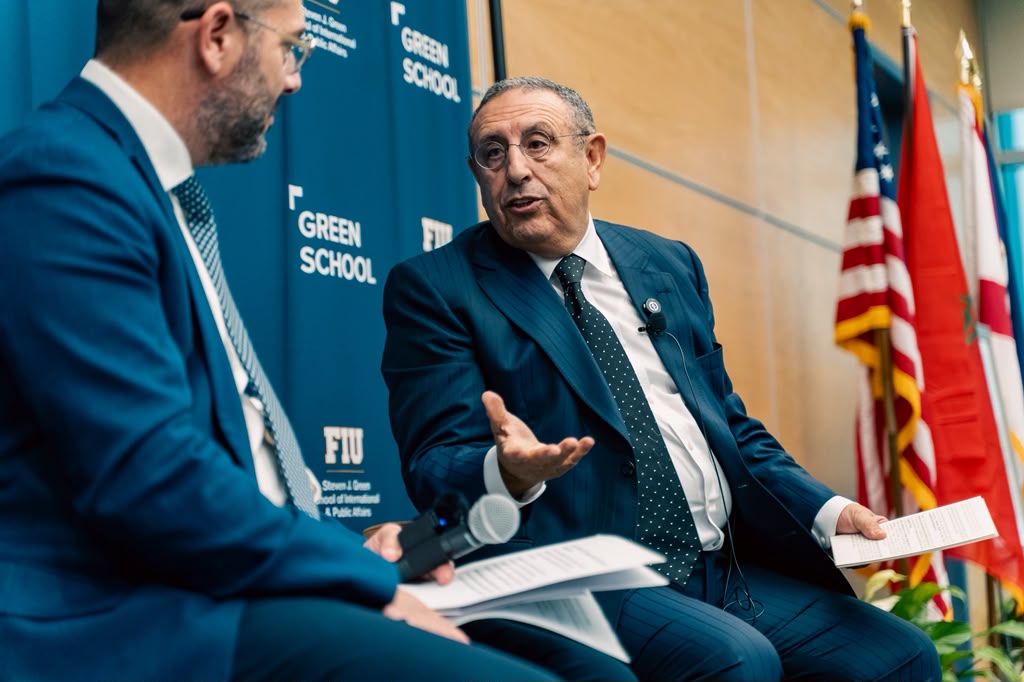
Rabat – Morocco wants to turn its geographic position into a stronger economic and diplomatic advantage, with closer ties to the United States among its priorities, Morocco’s Ambassador to the United States Youssef Amrani said during a visit to Florida International University (FIU) in Miami.
Addressing American students, academics, and faculty members, Amrani presented Morocco’s development priorities and its ambitions for a greater role in international affairs. He also called for deeper economic ties between Rabat and Washington, with a focus on investment, industrial cooperation, and research.
The event took place at FIU’s Steven J. Green School of International & Public Affairs under the moderation of its dean, Dr. Shlomi Dinar. It formed part of the first edition of Morocco Days in Miami, held from October 22 to 24 on the initiative of Morocco’s Consulate General in Miami.
Amrani said Morocco’s position between Africa, Europe,
Amrani said Morocco’s position between Africa, Europe, the Arab world, and the Atlantic has shaped its history, but the country’s ambitions extend well beyond its role as a geographic link.
“Morocco does not choose between tradition and modernity. It combines both,” he said, describing national identity as al reform.
Morocco seeks a stronger place in global trade
Amrani presented Morocco’s economic transformation as a central part of its ambition to become a more influential player in international markets
Investment in infrastructure, industry, energy, and education has helped shape the country’s development priorities, he said. Morocco now seeks to strengthen its role in global supply chains and attract projects that create value beyond traditional trade.
The ambassador pointed to the Morocco-US free trade
The ambassador pointed to the Morocco-US free trade agreement as a key asset in this effort. Morocco is the only African country with such an agreement with Washington, which gives businesses on both sides a framework to expand commercial ties.
He called for greater cooperation in manufacturing, innovation, and access to international markets, particularly at a time when companies place greater importance on reliable partners and secure supply chains.
For Morocco, the goal is to translate its economic advantages into concrete partnerships with American businesses rather than rely on trade alone.
Women’s representation reflects broader change
The conference also addressed changes within Moroccan society, particularly the growing role of women in public institutions, education, business, and research.
Amrani cited an increase in women’s representation
Amrani cited an increase in women’s representation in Parliament from two in 1993 to 107 today as an example of the country’s institutional evolution.
He also referred to the appointment of Fatima Zahra El Mansouri as head of government, which he described as a historic milestone for Morocco.
The ambassador argued that women’s participation is essential to the country’s development and forms part of a wider effort to prepare Morocco for future challenges.
His remarks linked social change to the country’s
His remarks linked social change to the country’s broader ambitions: economic progress, he suggested, requires institutions and a society that allow more people to contribute to national development.
Morocco links regional stability to economic opportunity
Amrani also outlined Morocco’s approach to international relations, which he said rests on clear positions, reliable commitments, and long-term partnerships.
He argued that political stability cannot last without economic opportunities and cooperation among neighboring countries. He pointed to Morocco’s engagement across Africa as an example of its efforts to connect development with regional security.
One initiative he highlighted was King Mohammed VI’s proposal to give landlocked Sahel countries access to the Atlantic Ocean. The project aims to improve regional connectivity and help these countries reach international markets through new economic and logistical links.
Amrani presented the initiative as an effort
Amrani presented the initiative as an effort to turn a geographic constraint into an economic opportunity, with potential benefits for trade and regional integration.
Miami emerges as a potential bridge between Morocco and the US
The ambassador also highlighted Miami’s potential to strengthen economic relations between Morocco and the United States.
Southern Florida offers access to Latin America and the Caribbean, while Morocco maintains close links with African and European markets. Amrani said the two locations could use this geographic complementarity to develop projects in trade, logistics, tourism, and innovation.
He cited the direct air connection between Casablanca and Miami, along with the 2025 twinning agreement between Miami-Dade County and the Casablanca-Settat region, as foundations for closer cooperation.
For American companies that look toward Africa, Morocco
“For American companies that look toward Africa, Morocco offers much more than a gateway: it offers a reliable partner to build, produce, and succeed together,” he said.
The message to the university audience was clear: Morocco wants its longstanding relationship with the United States to deliver more tangible economic benefits, particularly through business partnerships and investment.
Students and universities have a role to play
Amrani also urged greater academic cooperation between Morocco and the United States, particularly in areas where both countries face shared challenges.
He identified water, energy, climate resilience, and women’s entrepreneurship as promising fields for joint research and university exchanges.
The ambassador said diplomacy now extends well beyond
The ambassador said diplomacy now extends well beyond official relations between governments. Businesses, universities, research laboratories, and young professionals also shape international partnerships and determine whether political commitments translate into practical results.
“Governments can conclude agreements, but it is the women and men we educate today who will give them their full meaning tomorrow,” he said.
Amrani closed by recalling the longstanding historical ties between Morocco and the United States, which date back to Morocco’s early recognition of American independence.
Nearly 250 years later, he said, both countries have an opportunity to build on that history through cooperation that creates new opportunities for their people.